You're billing $150 an hour. Maybe $200. Perhaps $300.
You wouldn't spend six hours researching office chairs. You wouldn't take three afternoons comparing printer suppliers. You certainly wouldn't personally negotiate your building's cleaning contract.
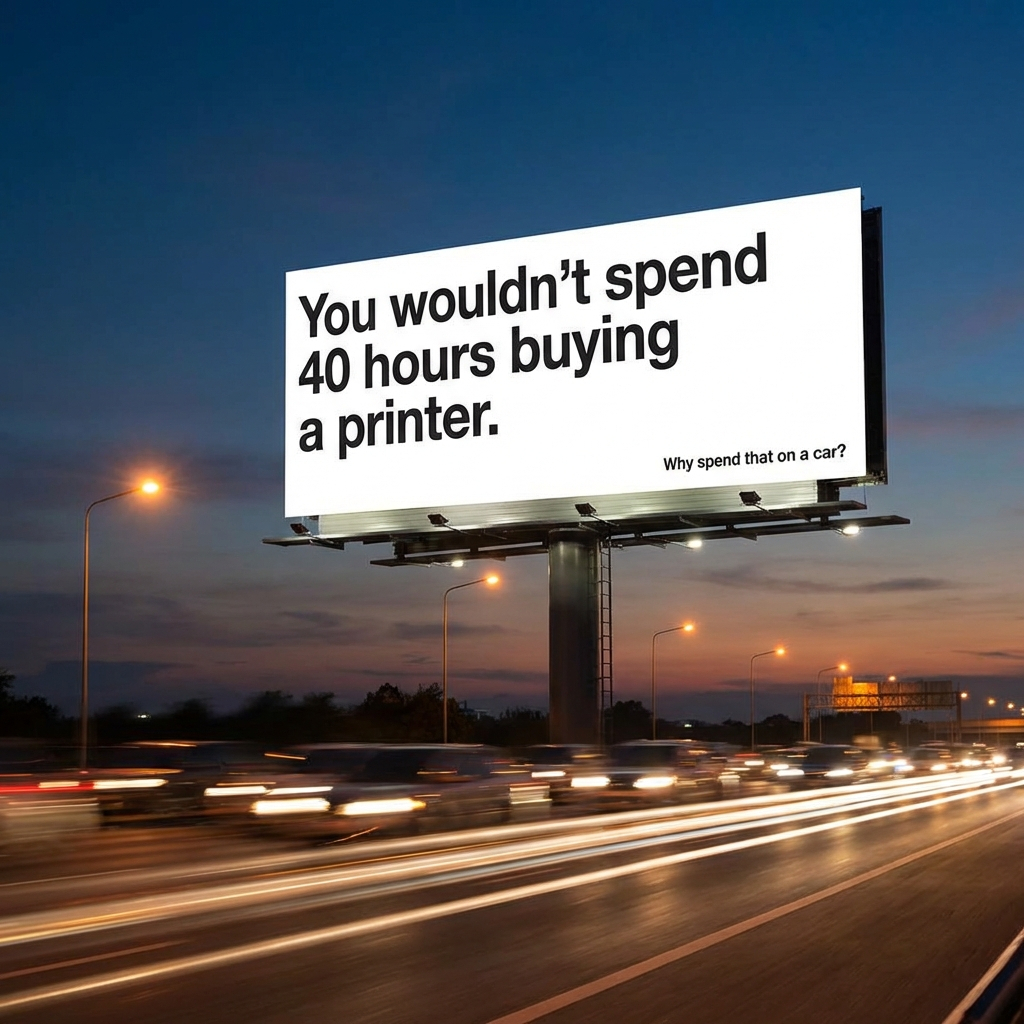
But when it comes to buying a car, intelligent people routinely spend 20 to 40 hours doing exactly that.
The maths doesn't work. It never did.
The Hidden Time Cost Nobody Calculates Let's put actual numbers to the traditional car-buying process.
Research and shortlisting takes 5 to 10 hours. Tabs open, reviews compared, availability checked, trims analysed.
Dealership visits consume another 6 to 12 hours. Three dealers minimum. Test drives, waiting around, repeating the same conversation with different salespeople who all claim they'll "do their best" on price.
Negotiation and quote chasing adds 4 to 8 hours. Phone calls that go nowhere. Emails with "let me check with my manager" energy. Quotes that shift when you try to lock them down.
Finance coordination takes 3 to 6 hours. Applications, document uploads, lender back-and-forth, settlement timing coordination.
Admin drag accounts for another 2 to 4 hours. Contracts, registration, insurance, delivery logistics, and the inevitable 4:45pm phone call on a weekday.
Total: 20 to 40 hours of actual time.
Now apply your hourly rate.
At $150 per hour, that's $3,000 to $6,000 in opportunity cost.
At $200 per hour, it's $4,000 to $8,000.
At $300 per hour, it's $6,000 to $12,000.
Why High Earners Keep Making This Mistake The pattern is consistent across professions.
A senior accountant billing $180 per hour. A project manager on $150 consulting to multiple clients. An experienced physiotherapist running their own practice at $200 per session. A software contractor charging $250 per hour.
They all assume the same thing: "How hard can it be?"
The answer is: not hard. Just slow, fragmented, and structurally inefficient.
According to Cox Automotive , the average car buyer spent 14 hours and 39 minutes on the process in 2022. That's an 18% increase from the previous year.
Customer satisfaction dropped from 66% to 61% in the same period.
More time. Worse outcomes. That's the trajectory.
The Opportunity Cost Framework Nobel laureate Gary Becker's research on time economics found that middle-aged consumers pay approximately 5% more for identical goods because their opportunity cost of time is roughly 40% higher than retirees.
The implication is clear: when your time is valuable, you already subsidise inefficient decision-making.
Households earning over $100,000 pay 5% more on average for the same item compared to households earning under $50,000. The difference isn't knowledge. It's bandwidth.
High earners don't have the luxury of spending three Saturdays visiting dealerships. They make faster decisions under time pressure, which often means accepting suboptimal terms just to close the loop.
That's not a character flaw. It's a structural reality.
What Delegation Actually Looks Like You don't see litigation attorneys changing their own oil.
You don't see plastic surgeons mowing their own lawns.
The decision isn't about capability. It's about financial logic.
When we run sealed competitive discovery for a client, the spread between the highest and lowest dealer bids is typically $2,000 to $4,000 on a $60,000 to $150,000 vehicle. On high-demand models with tight supply, that gap can reach $5,000 to $10,000 or more.
That variance exists because different dealers have different stock positions, monthly targets, manufacturer incentives, and appetite for margin. One dealership might need your exact build to hit a volume bonus before month-end. Another might be quoting off incoming allocation and pricing in uncertainty.
Most buyers never see that spread because they only negotiate with one dealer at a time.
We see it side-by-side.
The Leverage Shift You Can't Recover From The moment a dealer knows who you are, the dynamic changes.
Before identification, it's clean competition. Just a spec, a timeframe, and a number. Dealers quote against other dealers.
After identification, it becomes a relationship sales process.
Follow-up starts. Calls, check-ins, "just popping this in your inbox" messages. The conversation becomes harder to compare because offers get bundled with trade-ins, finance packages, accessories, and moving targets.
It's not malicious. It's how the retail model is built.
Dealers are optimised to close the individual in front of them, one at a time. That's their job.
Keeping the buyer protected until the best deal is actually earned preserves leverage. That's the structural difference.
The Finance Office Playbook The finance office is where complexity spikes.
You're tired. You're committed. You're ready to be done.
Three patterns show up consistently:
Bundling. The conversation shifts from rate to a single weekly repayment number, with insurance, add-ons, warranties, and extras folded in. It becomes difficult to see what you're actually paying for.
Urgency. Everything happens in the final hour. "This offer is only valid today." "We need to submit this now." You're already over the finish line emotionally, so friction feels expensive.
Optionality overload. Multiple loan terms, balloon structures, different lenders, different packages. You're presented with a menu under time pressure, which makes clean evaluation nearly impossible.
None of this is inherently wrong. It's just how the system works.
But for high-income buyers, the cost of confusion is real.
The Fragmentation Problem When you handle the process yourself, you're dealing with 6 to 10 different people.
The front-line salesperson. The sales manager who controls actual pricing. The finance manager in the back office. The trade-in appraisal team. The aftermarket person pitching tint and paint protection. The delivery coordinator. The lender contact. The insurance conversation. The admin staff processing contracts.
That's a lot of repeated explanations, duplicated paperwork, and moving parts.
Each handoff introduces friction. Each conversation requires context-setting. Each person has different priorities and different information.
The coordination cost alone justifies delegation.
Why June Matters (And Why It Doesn't) EOFY is one of the few periods where discounts can be real.
Behind the scenes, three things happen:
Dealer targets and manufacturer bonuses come into play. Many dealerships have quarterly or annual volume thresholds. Hit the number, trigger significant incentives. Miss it, lose them. That creates genuine willingness to sharpen pricing on the right cars.
Stock and allocation pressure builds. EOFY is a clearing moment. Dealers want to move certain builds before the next allocation cycle or model-year shift.
Finance and business buyer timing accelerates. June pulls forward a wave of tax-driven purchases, especially in the $60,000 to $150,000 bracket.
But there's theatre too.
Theatre is the generic "EOFY sale" banner slapped on cars that were never going to be discounted meaningfully. Theatre is urgency without substance.
The real discounts are specific, targeted, and usually tied to a dealer's exact situation that week.
Knowing the difference requires visibility across multiple dealers simultaneously. That's not something you can achieve through sequential conversations.
The Actual Question The question isn't "Can I do this myself?"
You can. You're intelligent, capable, and resourceful.
The question is: "Why would I?"
When the time cost exceeds the service cost by a factor of five or ten, delegation isn't luxury. It's financial logic.
When competitive discovery produces a $5,000 better outcome in exchange for zero hours of your attention, the maths is straightforward.
When privacy protection prevents three months of follow-up calls and email chains, the value is immediate.
High-performing people delegate because they understand opportunity cost. They hire accountants, lawyers, and advisers not because they lack capability, but because their time is better spent elsewhere.
Vehicle acquisition is no different.
The process requires slow, fragmented admin work. You're optimised for decisive action, not for chasing quotes and comparing fine print across disconnected systems.
That's the structural mismatch.
What Happens Next If you're earning $100 to $300 per hour and you're about to buy a car, run the calculation.
Estimate your actual hourly value. Multiply by 20 to 40 hours. Compare that to the cost of having someone handle it properly.
Then ask yourself whether you'd rather spend those hours doing your actual work, or navigating dealership conversations and finance paperwork.
The answer tends to be obvious.
If you'd like to see how competitive discovery works in practice, send through the model and timeframe. We'll handle it from there.






.png)
.png)
